


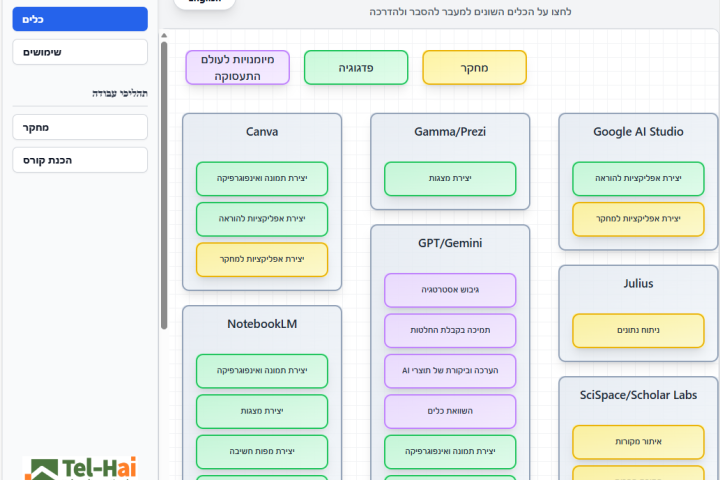
In an era in which almost every new AI tool is accompanied by dozens of guides, lists, and comparisons across the web, there is a growing need for a focused, reliable, and highly relevant map tailored specifically for academic staff. The AI Skills and Tools Map developed by the Unit for Excellence and Innovation in Teaching is designed to bring order to the abundance of information and to present a clear and up-to-date picture of the tools and capabilities that truly contribute to teaching, research, and student training.
The uniqueness of the map lies in the dual perspective it offers: from required uses to the appropriate tools, and from existing tools to the possible uses they support. This means you can begin with a specific academic task—such as writing, assessment, or lesson planning—and discover which tools support it, or start with a familiar AI tool and explore the contexts in which it can be integrated. In addition, the map emphasizes work processes rather than merely listing applications, and focuses on tools that have been tested and found particularly suitable for the needs of academic staff.
The map presents the connections between academic skills and AI tools that can assist in developing them. It is divided into three main domains—Teaching, Research, and Preparing Students for the Workforce—each marked in a different color. This makes it easy to see how artificial intelligence integrates into each dimension of academic activity.
?How to use it
:You can switch between two main views
-
“Tools” view – The map is organized by well-known AI tools such as GPT, NotebookLM, or SciSpace, and under each tool you will find the academic skills it can support.
-
“Uses” view – The starting point is the skill, such as “Academic Writing” or “Literature Review,” and underneath are the recommended tools for performing the task. Switching between the views is done with a single click.
Clicking on a tool card opens a short information window including: a description of the tool, its academic value, the added benefit of AI, and an example of possible use in teaching or research. In this way, the map enables lecturers and researchers to gradually become familiar with different tools, understand what suits their needs, and experiment in an informed and thoughtful manner.
The map is continuously updated in accordance with technological developments and emerging needs from the field. In the future, it will also include direct links to short instructional videos demonstrating practical uses of the various tools and skills. This way, you will not only read about a tool, but also see how it is implemented in diverse academic contexts.
The map is intended to serve as a living working resource that accompanies us in addressing the new challenges created by artificial intelligence. It invites you to explore, experiment, ask questions, and discover new ways to integrate AI capabilities into your work.