



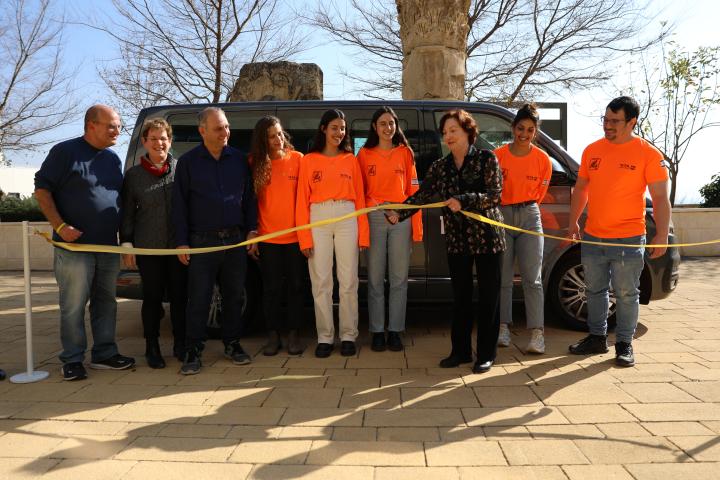
The challenging security situation in the Galilee, has significantly impacted the mental well-being of it’s residents. The Mental Resilience Mobile Unit, recently inaugurated at Tel-Hai, is designed to help address this complex reality. This initiative was made possible through the generous donation of the Arnold and Anita Silber Family Foundation.
This specially equipped vehicle, with its advanced equipment generously donated by Keren Hayesod, serves as a transformative tool, ensuring that immediate psychological first aid is accessible directly in the field. The vehicle will be deployed to disaster sites alongside Magen David Adom (MDA), Fire and Rescue Services, police forces, and other emergency responders across the country, providing immediate psychosocial assistance.
Operated by expert students who have undergone extensive practical training and have already provided immediate mental health support during emergencies and disasters, including the rocket attacks in northern Israel over the past year, the unit enables swift trauma interventions, reaching those in need almost anywhere thanks to its versatility and mobility.
The Resilience Mobile Unit also serves as a platform for psychological first aid training, allowing teams to conduct community-based sessions in remote areas. These sessions aim to strengthen community resilience by providing simple tools for effective psychological first aid.
At the heart of this initiative is the pioneering Six C’s model, developed by Dr. Moshe Farchi, Head of the Social Work Department at Tel-Hai and a national authority on stress and anxiety intervention, in collaboration with Dr. Einav Levy, Head of the Stress, Trauma, and Resilience Track, and their dedicated students. This model, recognized as Israel's psychological first aid framework, underpins the unit's approach to restoring functionality and empowering individuals in times of crisis.
A recent article published on Ynet [https://www.ynet.co.il/yedioth/article/yokra14222329] highlights the challenges faced by the region in the aftermath of the war.
The article cites a recent study conducted by the Regional Knowledge Center of Tel-Hai and the Eastern Galilee Cluster, which reveals concerning findings.
The research included 1,933 residents, half of whom were evacuated from their homes and half who remained in their communities in the Eastern Galilee despite over a year of ongoing attacks. 36% of evacuees and 24% of those who remained, reported seeking professional mental health support to cope with the war’s effects. The study also revealed a significant increase in high risk health behaviors: 54% of evacuees and 40% of non-evacuated residents reported smoking cigarettes, 51% of evacuees and 53% of non-evacuated residents reported taking sedatives, 39% of evacuees and 33% of non-evacuated residents reported increased alcohol consumption.
"The difficulties are emotional, financial, and social," explains Dr. Farchi. "We are witnessing high rates of health-risk behaviors, and these residents may experience heightened anxiety in the event of a disaster or security tension."
Early intervention in the initial stages of exposure to a traumatic event can be crucial in reducing stress symptoms and preventing long-term post-traumatic distress. This is precisely the mission of the Mental Resilience Mobile Unit—to provide timely support and mitigate lasting psychological impacts.
The mobile unit, a 4x4 off-road vehicle, is equipped with advanced systems and uniquely designed features. Its interior includes specially designed benches for face-to-face seating, creating a small “clinic” for initial psychosocial intervention.
The vehicle is also outfitted with: three independent communication stations, cooling and lighting systems, food supplies for prolonged stays, and first aid equipment.
Additionally, the unit supports live-streaming and wireless transmission, enabling both in-person and remote training sessions simultaneously.
Beyond its role in providing on-site mental health intervention, the vehicle can also transport anxiety victims while offering treatment during the journey. If needed, it can even serve as a forward command post (FCP) in emergency situations.
This initiative embodies Tel-Hai’s commitment to blending academic excellence with practical impact, giving students invaluable field-based experience while serving the vital needs of the northern communities we call home.