
Tel-Hai – University of Kiryat Shmona in the Galilee sees great importance in promoting gender equity and diversity and creating an equal academic environment, with an appropriate representation for women across all ranks and positions. 

Promoting Gender Equiyt at Tel Hai University of Kiryat Shmona in the Galilee


The Gender Equity Unit was established at Tel-Hai College in 2018 in order to deal with the underrepresentation of women in senior faculty and high academic ranks, which is characteristic of high education institutions in Israel and around the world. 

In line with the spirit of the new university, the Unit’s aim is to promote a fair and equal environment by raising gender awareness and pointing out organizational and pedagogical practices or activities that exclude or discriminate against individuals based on gender, and other oppressed intersectionalities. The Unit develops and encourages alternative practices, sensitive to the differences and diversity within the academic community, allowing gender equity at every level. 

Studies show that diversity in academic research and industry environments brings new voices to these spaces and increases creativity and innovation, which are key values in academic institutions in general and at Tel-Hai in particular.
As an institution that trains female students to become leaders in a variety of disciplines, both within and outside the academic sphere, the presence of female researchers and chief administrators is of paramount importance. As Marian Wright Edelman asserts, "you can't be what you can't see."

Tel-Hai – University of Kiryat Shmona in the Galilee works to promote gender equity and equality in line with the European Gender Equity Plan. The Unit receives partial funding from the Israeli Council for Higher Education (CHE) through its Equator Index program. The rest of the funding comes from Tel-Hai. 


The Unit works in the following areas:

  • Programs designed to promote academic writing and research
  • Workshops to raise awareness of implicit and hidden gender bias
  • Surveys and monitoring of women's promotion and resource allocation at Tel-Hai
  • Raising awareness of relevant procedures regarding employment, research, and teaching conditions
  • Grants for female researchers early in their academic careers and at various stages of promotion
  • Raising awareness regarding the integration of the gender component into research and teaching 


Unit Members 

Consultant to the president on gender equity: Prof. Susana Pendzik, Associate professor in the Drama Therapy Graduate Program ([email protected]) 

Dr. Iris Zohar, Senior Lecturer in the Environmental Science and MSc program of Water Science, and head of the Soil & Water Geochemistry and Biogeochemistry Lab ([email protected])

Dr. Sharon Egozi, Senior Lecturer in the Social Work Program and head of the MA Program for Holders of Other Degrees ([email protected])

Unit coordinator: Shaam Kassem Ali, MSc. Student of biotechnology ([email protected]) 
 

Accordion Title About

About

In line with the Israeli Council for Higher Education’s (CHE) 2015 decision to promote gender equity and equality, Dr. Tamar Arieli was appointed as consultant to Tel Hai’s president on gender equity. In 2016, Prof. Nurit Carmi succeeded Dr. Arieli’s and recruited a team of researchers – Prof. Tamar Hagar, Dr. Sharon Egozi, Dr. Yael Kedar, and Dr. Ilana Hairston – to develop Tel-Hai's unique work model for promoting gender equity. At the heart of this model is a dedicated team working together to address organizational inequality. 

Following the successful application for a competitive grant from the CHEt o promote gender equity in academic institutions, the Gender Equity Unit was established in 2018, and remains active to this day. 
The Unit consists of four members: Prof. Susana Pendzik, who also serves as a consultant to the president on gender equity, Dr. Sharon Egozi, Dr. Iris Zohar, and Shaam Kassem Ali, the Unit’s coordinator.

In 2021, the Unit was awarded the CHE Equator Index grant – a multi-year program dedicated to advancing gender equity within higher education.  Following CHE’s established principles for the promotion of women to senior faculty positions, the program focuses on raising institutional awareness regarding gender equity and actively recruiting and promoting female researchers. A key priority is to increase representation in fields like exact sciences and engineering, where female representation is especially low. 

Accordion Title Activity

Activity

The Unit's activities are designed to promote gender equity and equality within the new university, by reducing the gaps between men and women among senior faculty and in key positions, and by monitoring the progress of these processes.


Scholarly publishing and research 

The Unit recognizes the importance of creating spaces where female participants can work on their research and academic writing without distractions.  The program consists of the following:

1.    Two annual three-to-four-day retreats, held in enjoyable and comfortable locations outside of the university, subsidized by the Unit. The retreats provide opportunities to work in peace and solitude as well as the chance to discuss work progress with colleagues, receiving feedback and support. Optional relaxing activities are also available, such as sports or short hiking trips. 

2.    Mini-retreats: Zoom sessions for groups of female researchers, providing a dedicated work time slot.  Developed during the COVID-19 pandemic, this model helps women to find time for their research. Each session begins with a discussion about participants' individual goals, after which each member turns to their own predefined tasks. There is a recharge break every 45-60 minutes, and the session ends with a short concluding discussion about the insights gained during the process. Sessions are advertised via email and are open to all interested colleagues.  
3.    Research grants. Thanks to the fundings provided by the CHE's Equator Index program, the Unit allocates research grants to female academics every year, based on need. Researchers at all levels may apply for calls for proposals to promote research initiatives. 


Raising awareness to implied gender biases

1.    Conferences, day seminars, lectures and workshops, designed to present data on inequality in academia in general and at Tel-Hai in particular, and to discuss ways of  dealing with it. These activities are intended for various groups, including Tel-Hai’s management, the dean forum, and the entire staff. Individual meetings are also held with various position holders.

2.    Monitoring the situation through qualitative studies and gender-related surveys on gender needs completed by both male and female faculty members.


Mentoring

Studies around the world have shown that female academics in every discipline encounter multiple barriers that hinder their professional progress. In a survey we conducted in 2018, female staff indicated that a mentorship program could help them overcome some of these obstacles. Consequently, two mentoring programs were launched for senior and junior staff: one in the Faculty of Social Sciences & Humanities and the other in the Faculty of Sciences & Technology. These programs are currently run ad hoc. 


Handling sexual harassment on campus

Academia is a hierarchical institution, operating within a complex system of relative power, which can often create an unsafe environment. Studies have suggested that female students, lecturers, and administrators have little motivation to use the existing mechanisms to handle these harmful situations. 

KALMA (an acronym for Community for Dealing with Sexual and Gender-related Harassment in Hebrew) is an active study group comprising male and female lecturers, students, and administrators. The group examines the existing mechanisms in place on the different campuses and studies community models that originated in a variety of locations around the world. The aim is to improve the response to men and women who have been hurt in the academia in general, and specifically at Tel-Hai. These activities ceased during the war, but we hope to resume them. To learn more about KALMA, please email Prof. Tamar Hager (former head of the Unit) at [email protected]. 

Accordion Title Monitoring women's promotion at Tel-Hai

Monitoring women's promotion at Tel-Hai

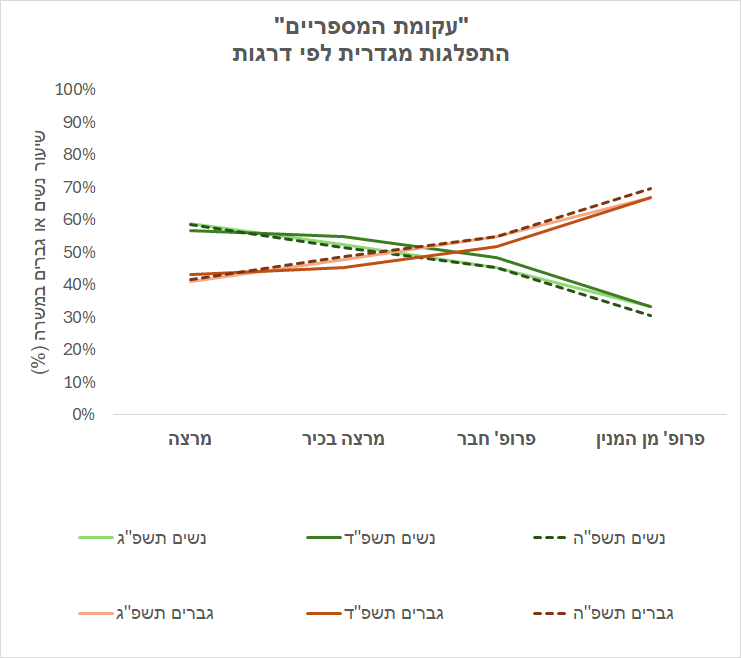
Similar to what takes place in other academic institutions in Israel and worldwide, at Tel-Hai University, women are underrepresented at higher academic ranks (associate professor and professor), despite of the fact that they are overrepresented at the lower academic ranks (lecturer/senior lecturer). Therefore, part of the Unit's job is to collect data on women's representation in the various ranks, in order to monitor the changes in their academic progress and their representation in key positions. 

תמונה
תרשים: התפלגות מגדרית לפי דרגות תשפג-תשפה

Right: Gender representation in senior academic positions; Left: Gender distribution across academic ranks (2021-2022 academic year). 

Graph for the years 2019-2020 to 2024–2025
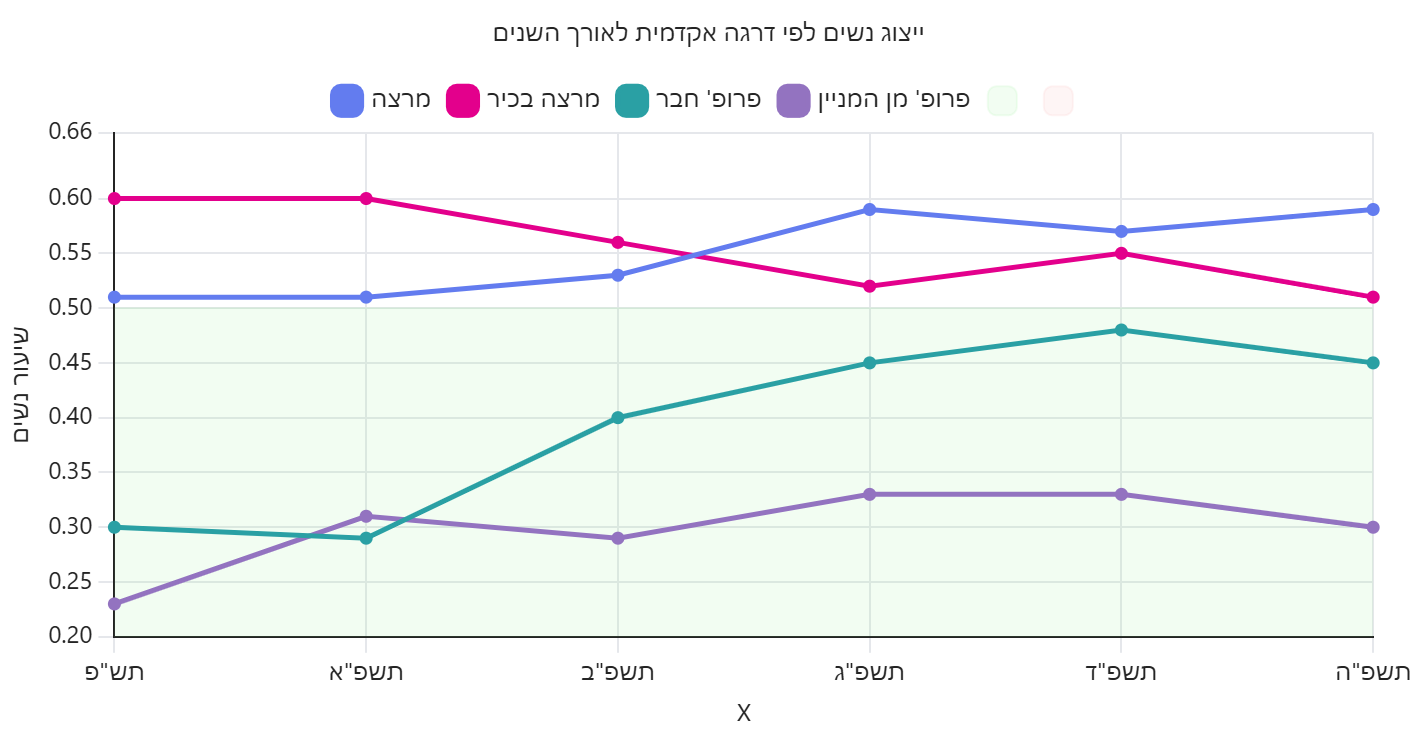
The differences for the years 2019–2020 to 2024–2025 can be seen in the following graph: 

תמונה
ייצוג נשים לפי דרגה אקדמית בשנים תש"פ-תשפ"ה

Examining the rates of men and women across the academic ranks at Tel-Hai between the 2019-20 and 2024-25 academic years, reveals a general trend, with certain shifts occurring overtime. 

As can be seen in the attached illustration, this general tendency results in a "scissors diagram", particularly in the years 2019-20 and 2020-21. This phenomenon illustrates the difficulties female members face in advancing from a senior lecturer position to an associate professor rank.

Positive changes have occurred in recent years, reducing the gender gap among holders of higher ranks. The most significant improvement can be seen in the proportion of female associate professors at Tel-Hai, increasing from 29% in 2020-21 to 40% in 2021-22, with the best results thus far being seen in 2023-24 at 48%. This improvement was preceded by an increase in the number of female professors. In that category, the gender gap narrowed as the proportion of women increased from 23% in 2019-20 to 31% in 2020-21. However, from that time until 2024-25, the gender gap at this senior level has remained at approximately 70% men and 30% women. 

Among other things, the Gender Equity Unit works to identify gender disparities in organizational structures, academic conduct, and the representation of women in high ranks roles and positions on various committees, as well as in the distribution of formal and informal rewards. 

The gender gaps identified through the Unit's regular checks and surveys highlight the challenges faced by female staff and inform the development of a work plan. 
In addition, the Unit conducts a qualitative, interview-based study to improve the understanding of the factors inhibiting or empowering women in the organization. The goal of the study is to improve our understanding of the gendered aspects of the female staff in the organization. 
 

Accordion Title Regulations

Regulations

•    Parental rights of male/female students 
•    Mutual aid fund: a special fund for helping university staff (academic or administrative) with uncommon, health or personal financial problems, such as life-threatening situations, sudden family crises, or help with hospitalization, nursing or recuperating needs in the lack of other financial sources.
•    Handling sexual harassment.
•    Participation in tuition in other academic institutes for staff spouses and children.
 

Accordion Title Grants

Grants

Research grants for fellow and senior faculty are offered every year by the Gender Equality Unit. Information about these grants, including application deadlines, is published on the website and distributed by mail each year. 

•    Fellow faculty grants are available to female PhD candidates in the final stages of their dissertation, and to PhD holders who teach at the university as fellow faculty members. 

•    Senior faculty grants are available to female senior faculty members who are employed regularly at Tel-Hai in every rank from lecturer to professor.

Research grant regulations for fellow faculty
Research grant regulations for senior faculty
 

Contact us