



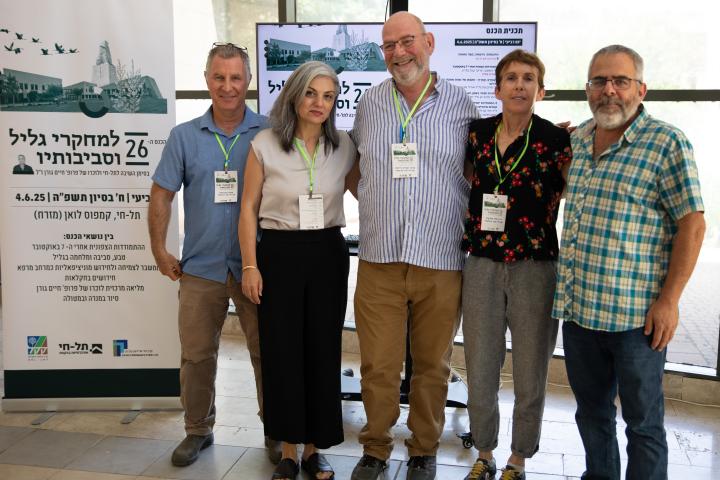
After a year and a half of evacuation, the Galilee Research Conference was held once again on the Tel-Hai campus—marking a symbolic return to the North and honoring the memory of Professor Haim Goren, one of the founding figures of Tel-Hai and founder of the conference.
Conference sessions addressed pressing issues currently facing the Galilee, including: the role of wives of reserve commanders; the experience of evacuation in Israel’s north during the Iron Swords War; the struggles of small businesses amidst ongoing crisis; the challenges facing agriculture in the Upper Galilee—from war to drought; the Northern Command's insights regarding military and civilian resilience; nature and the environment during and after the war; models for recovery, renewal, and future growth following extended displacement—and more.
The main plenary session was dedicated in memory of Prof. Haim Goren, one of Tel-Hai’s founding pillars, who devoted his academic life to shaping, developing, and advancing the institution. A distinguished historical geographer, he was among the first faculty members accredited to establish academic programs at Tel-Hai. He initiated three tracks that formed the basis for the college’s accreditation as an independent academic institution: the Multidisciplinary Studies Program (which he founded and headed), Education, and Social Work.
Over the years, he led the "Tel-Hai Cluster of Conferences" and the "Conference on New Galilee Research," through which he built extensive academic networks, brought leading scholars to Tel-Hai as guest speakers, and helped broaden the college's visibility nationally and internationally.
As Head of Research at the college, he played a central role in transforming Tel-Hai into a leading research institution and advancing its vision to become a university. As a longtime member of the Planning and Budgeting Committee of the Council for Higher Education, he strengthened Tel-Hai’s presence in national academic circles.
Prof. Goren also spearheaded the development of Tel-Hai’s rich library collection, including hundreds of rare books and one of the world’s largest and most advanced digital academic map collections. He was instrumental in establishing the M.A. program in Galilee Studies—another expression of his lifelong vision to connect academia with the geographic and social periphery.
Opening the commemorative session, Prof. Zevik Greenberg remarked:
“We gather here today with mixed emotions. On one hand, great joy—the joy of coming home. After more than a year of teaching far from our campus, which Goren helped envision and establish, and while the war still rages—we have returned. There is much work ahead: rehabilitation, renewal, and growth—of the college and of the Galilee—as part of our founding vision and our current mission to establish a university. The decision to hold the conference, despite the complexity, is a statement: a return to academic life. Alongside the joy is pain and remembrance. This year we lost three founding figures who shaped Tel-Hai over many years: Yehuda Levy, the Tel- hai’s first academic secretary; Prof. Shmuel Shamai; and Prof. Haim Goren. Three extraordinary figures who each, in their own way, helped bring Tel-Hai—today a university in the making—to its respected place in Israel’s academic landscape.”
Tel-Hai President, Prof. Eliezer Shalev, added:
"Haim was the spirit of Tel-Hai. A founder of the college, a member of the Council for Higher Education, and a mentor to generations of students—curious minds full of passion for knowledge. He will be remembered for his deep love for the Galilee, for hiking, for teaching, and for research."
Renowned historian Prof. Israel Bartal paid tribute to Prof. Goren, describing him as a rare academic figure and an outstanding historical geographer.
The session concluded with a lecture by journalist and author Chen Artzi-Sror, based on her new book “Shevet Achim: A New Operating System for Israel.” She presented a vision for a renewed Israeli discourse—one where East and West, Judaism and universalism, tradition and pioneering spirit coexist in pursuit of overcoming division and polarization.
The conference ended with two guided tours: one to Kibbutz Manara, led by community director Yochai Wolfin, and the other to Metula, led by Lior Baz, a third-generation descendant of the town’s founders.
We hope for the swift recovery of northern communities impacted by the war, and for the full return of residents to their homes.