
About the Laboratory

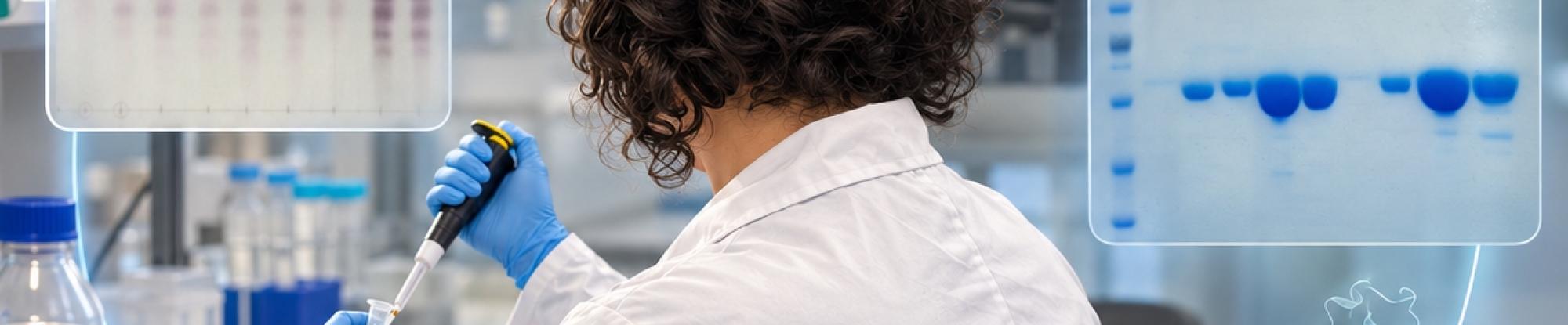
Research in our lab focuses on understanding how microbes evolve complex enzymatic pathways to cope with constantly changing environments. We are also interested in understanding structure-function relationships and engineering enzymes for specific industrial and therapeutic applications. By combining these areas of study, we aim to construct whole-cell factories to produce small and macro molecules. To address these questions and challenges, we use tools from the fields of biochemistry, microbiology, directed evolution, and genomics. Our goal is to apply the knowledge gained from our research to develop improved and custom-made proteins for therapeutic and industrial applications and to create enzyme-based processes to produce valuable molecules.


Current Projects 

  • Characterization of key enzymes from the microbial pathway for methionine biosynthesis
  • Development of sugar modifying enzymes for production of novel dietary fibers
  • Production of viral proteins in heterologous systems (in collaboration with Shahar and Pitcovski lab)
  • Metabolic engineering of microbial cells for production of rare sugars and amino acids
  • Development of soluble receptors for immunotherapy
     
Accordion Title Staff and Researchers

Staff and Researchers

Dr. Itamar Yadid - Head of Laboratory 

Mail: [email protected]

Nadya Gruzdev, PhD – research associate and lab manager 

Mail: 

Yara Diab – MSc student

Amit Levi – MSc student
 

Former students
Omri Cohen

Ksenia Semenov

Shira Sananes

Shaked Yaacov

Lee Hovav

Lidor Zohar

Ken Emquies

Maor Ifrach
 

Research at the Laboratory  

Research in the lab is aimed at understanding how microbes evolve complex enzymatic pathways to cope with the constantly changing environment. Additionally, we aim to engineer proteins to understand structure function relationships and for specific industrial and therapeutic applications, as well as construct whole cell factories to produce small and macro molecules. By employing biochemistry, microbiology, directed evolution, and genomic approaches, we strive to address fundamental questions and overcome challenges in these areas. Our ultimate objective is to apply the knowledge gained from our research to develop enhanced and customized organic molecules and proteins for therapeutic and sustainable industrial purposes. 

The current projects underway in our lab include:

The current projects underway in our lab include:

Accordion Title Construction of Soluble Fusion Proteins

Construction of Soluble Fusion Proteins

Construction of soluble fusion proteins derived from human membrane receptors and cytokines, and examination of their cellular effects on immune cells during inflammatory conditions. We are presently fusing the extracellular domain of the immune checkpoint protein CTLA4 with the anti-inflammatory cytokine IL10. This fusion protein is being evaluated for its capacity to decrease the secretion of inflammatory cytokines in a model system that mimics Inflammatory Bowel Disease (IBD).

Accordion Title  Investigation of the enzymatic pathways responsible for methionine biosynthesis in bacteria

 Investigation of the enzymatic pathways responsible for methionine biosynthesis in bacteria

Methionine, an essential amino acid, is synthesized by plants, fungi, and bacteria, but not by vertebrates. Our research focuses on the two main pathways, trans- and direct-sulfurylation, involved in bacterial methionine biosynthesis, which differ in their sulfur assimilation steps. We aim to determine the contribution of individual enzymes to methionine production levels, explore the relationship between catalytic activity and methionine production, and investigate the potential assembly of these enzymes into protein complexes.

Accordion Title Metabolic engineering of E. coli and lactic acid bacteria to produce rare sugars from whey water waste

Metabolic engineering of E. coli and lactic acid bacteria to produce rare sugars from whey water waste

Our approach involves redesigning sugar metabolism through the creation of novel metabolic pathways and employing directed evolution techniques. We analyze the impact of these manipulations on gene expression, fitness, and product formation. Specifically, we focus on engineering bacteria for Tagatose production.

Accordion Title Design of fructosyltransferases and endoinulinases enzymes for the synthesis of short-chain fructooligosaccharides

Design of fructosyltransferases and endoinulinases enzymes for the synthesis of short-chain fructooligosaccharides

Fructooligosaccharides are dietary fibers composed of fructose, which can be naturally occurring or enzymatically synthesized and utilized in various food applications. Our research combines directed enzyme evolution, analytical chemistry, and microbiology to investigate the structure-function relationships of these enzymes and elucidate the mechanisms governing fiber length.

Accordion Title Development of microbial systems for the production of functional proteins

Development of microbial systems for the production of functional proteins

Collaborating with the lab of Itai Bloch, we employ bioinformatics and computer-assisted design to identify proteins suitable for use as ingredients in the food industry. Through recombinant DNA techniques and fermentation technologies, we express and produce significant quantities of these proteins, examining their physicochemical characteristics and evaluating their potential as alternative protein sources in the food industry.

Accordion Title Selected Publications

Selected Publications

  1. Cohen A, Gabay M, Cohen O, Sova M, Liberman A, Shemer A, Bloom N, Jacoby E, Cafri G, Avni D, Yadid I and Gal M. Engineering, production, and biochemical characterization of a human CTLA-4 and IL-10 bispecific fusion protein. Front. Bioeng. Biotechnol. 14:1964032. 2026


  2. Abzach A, Ben-Adiva R, Gruzdev N, Musa S and Yadid I. Engineering of Escherichia coli for D-Tagatose Production from Lactose and Whey Permeate via the Tagatose-6-Phosphate Pathway. CRFS. Volume 12, 2026, 101370. https://doi.org/10.1016/j.crfs.2026.101370


  3. Gabay M, Stern I, Gruzdev N, Cohen A, Adriana-Lifshits L, Ansbacher T, Yadid I, Gal M. Engineering of methionine-auxotroph Escherichia coli via parallel evolution of two enzymes from Corynebacterium glutamicum's direct-sulfurylation pathway enables its recovery in minimal medium. Metab Eng Commun. 2024 May 10;18:e00236. doi: 10.1016/j.mec.2024.e00236.


  1. Gruzdev N, Katz C, Yadid I. Curing of a field strain of Salmonella enterica serovar Infantis isolated from poultry from its highly stable pESI like plasmid. J Microbiol Methods. 2024 May 22;222:106959. doi: 10.1016/j.mimet.2024.106959 


  1. Gruzdev N, Hacham Y, Haviv H, Stern I, Gabay M, Bloch I, Amir R, Gal M, Yadid I. Conversion of methionine biosynthesis in Escherichia coli from trans- to direct-sulfurylation enhances extracellular methionine levels. Microb Cell Fact. 2023 Aug 11;22(1):151. doi: 10.1186/s12934-023-02150-x


  1. Endotoxin-free Gram-negative bacterium as a system for production and secretion of recombinant proteins. Shahar E, Emquies K, Bloch I, Eliahu D, Ben-Adiva R, Pitcovski J, Yadid I. Appl Microbiol Biotechnol. 2022 Nov 29 doi: 10.1007/s00253-022-12295-1 


  1. Protection against avian coronavirus conferred by oral vaccination with live bacteria secreting LTB fused viral proteins. Lublin A, Katz C, Gruzdev N, Yadid I, Bloch I, Farnoushi Y, Simanov L, Berkowitz A, Elyahu D, Pitcovski J, Shahar E. Vaccine. 2022 Jan 31;40(5):726-733. 


  1. Afriat-Jurnou L, Cohen R, Paluy I, Ben-Adiva R, Yadid I. Directed evolution of an endoinulinase from Talaromyces purpureogenus toward efficient production of inulooligosaccharides. Biotechnol Prog. 2018 Jul;34(4):868-877. 


  1. Brand Shwartz M, Assor M, Dotan N, Ratzon E, Cohen E, Ruimi N, Bloch I, Gal M, Yadid I. Inhibition of PD1:PD-L1 interaction by an E. coli-derived optimized PD1 variant. Biochem Biophys Res Commun. 2018 Nov 30;506(3):731-738. 

  2. Smock RG, Yadid I, Dym O, Clarke J, Tawfik DS. “De Novo Evolutionary Emergence of a Symmetrical Protein Is Shaped by Folding Constraints” Cell. 2016 Jan 28;164(3):476-86.